The 2026 Shift to Digital Showrooms: How Brands are Saving 30% on Operations
Advertisements
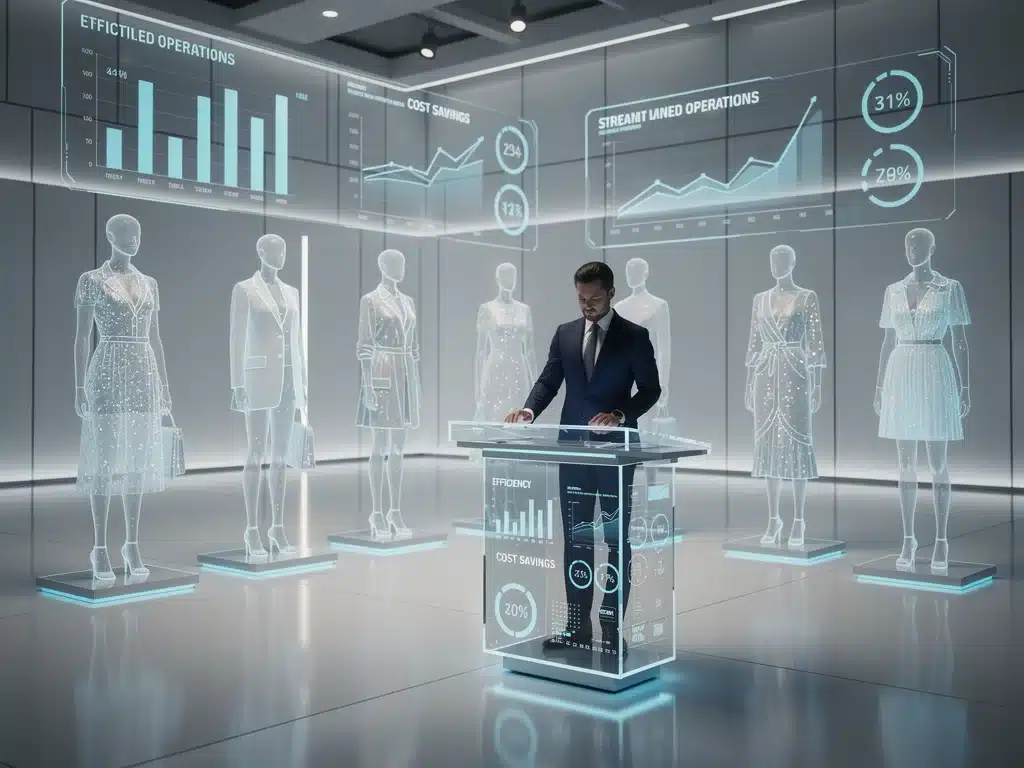
Digital showrooms are changing how fashion and retail brands present collections, collaborate with buyers and manage wholesale sales.
They can reduce physical sampling, shipping and travel while providing remote access to product information, but cost savings vary significantly by company and implementation.
Digital Showrooms are becoming an important part of wholesale fashion and retail as brands combine digital product visualisation with remote buying, ordering and collaboration tools.
Advertisements
Rather than replacing every physical showroom, these platforms increasingly complement traditional appointments by allowing buyers to review collections and place orders without being in the same location as the brand.
The transition can reduce some costs associated with global brands, physical samples and supply chains, although the financial impact depends on each company’s scale and existing processes.
The Accelerating Pace of Digital Transformation in Retail
The retail and fashion industries continue to digitise activities that were traditionally centred around physical samples, showrooms, trade fairs and in-person buyer appointments.
Digital wholesale platforms now combine product imagery, 3D assets, pricing, inventory information and ordering tools in environments that buyers can access remotely.
Rather than becoming a universal replacement for physical retail, the emerging model is increasingly hybrid, combining face-to-face interaction with always-available digital tools.
From Physical Showrooms to Hybrid Wholesale
Physical showrooms remain useful when buyers need to inspect fabrics, fit, construction or other characteristics that are difficult to assess completely through a screen.
Digital environments can complement those meetings by providing access to additional colours, styles and product information that may not be physically available at every appointment.
This hybrid model can reduce the number of samples and trips required while preserving physical interactions when touching or inspecting a product remains valuable.
Why Brands Are Investing in Digital Platforms
Digital platforms can provide buyers with access to collections outside traditional market weeks or scheduled showroom appointments.
Brands may also use them to centralise product information, reduce manual ordering processes and connect wholesale sales with inventory and customer-management systems.
The business case therefore extends beyond visual presentation, involving sales operations, data management and the efficiency of the wider wholesale workflow.
Understanding the Economic Case for Digital Showrooms
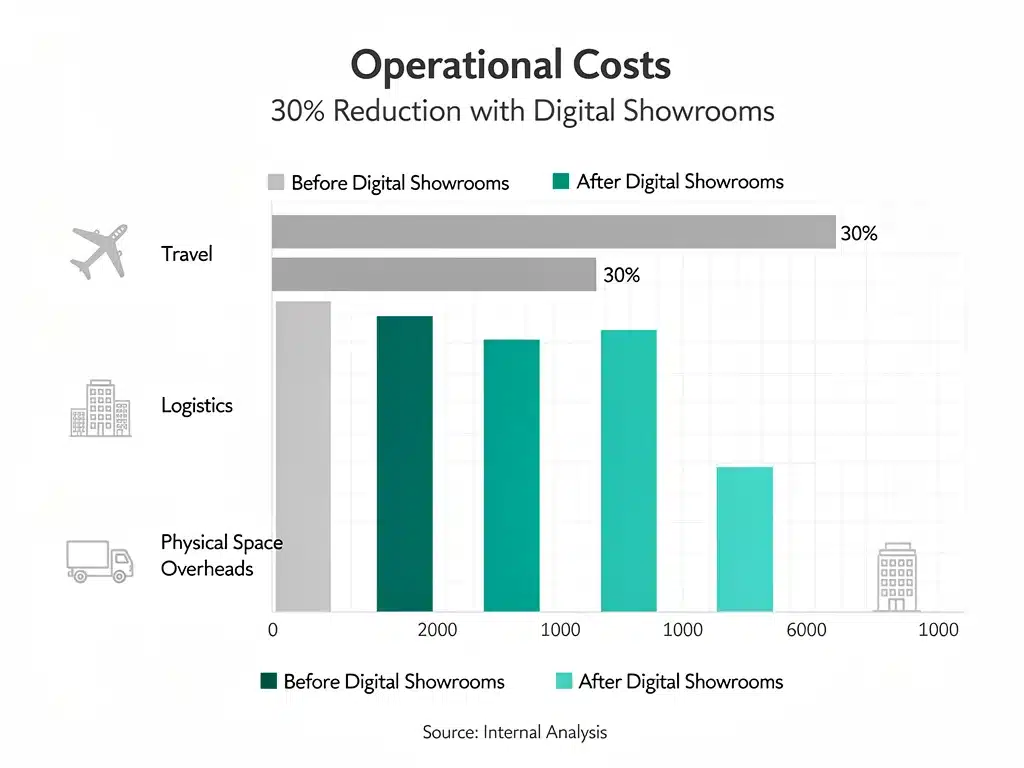
There is no reliable industry-wide rule stating that digital showrooms automatically reduce operating costs by exactly 30%, despite claims sometimes associated with the technology.
Actual savings depend on factors including the number of physical samples previously produced, international travel, showroom costs, technology investment and the scale of wholesale operations.
The strongest economic case is therefore based on specific cost categories that can be reduced rather than promising a universal percentage of savings.
Reduced Logistics and Travel Costs
Digital product presentations can reduce the need to ship complete sample collections between offices, showrooms and international buyers.
Remote appointments can also reduce some business travel for sales teams and buyers, particularly during early assortment reviews or follow-up meetings.
Neither expense disappears completely in every organisation, but reducing unnecessary sample movements and travel can generate meaningful operational efficiencies.
- Fewer physical samples may need to be shipped internationally.
- Some buyer and sales meetings can take place remotely.
- Brands may reduce customs, freight and sample-handling requirements.
- Reduced transport can also lower emissions associated with selected activities.
Optimised Physical Space Utilisation
Digital showrooms can reduce dependence on large permanent presentation spaces, particularly when portions of a collection are shown digitally.
Some companies may use smaller physical showrooms or complement limited sample selections with digital representations of additional colours and products.
However, technology does not automatically eliminate real-estate costs because many brands continue to operate physical showrooms alongside their digital platforms.
Reduced Physical Sampling
Digital prototypes and 3D product assets can reduce the number of physical samples required during design, approval and wholesale selling processes.
McKinsey has noted that digital prototypes can reduce physical sampling and allow smaller retailers to review collections remotely without travelling to a showroom.
The amount saved depends on product complexity and the accuracy required, as certain garments and materials may still need physical validation before production.
Technological Innovations Powering the Digital Shift
The development of Digital Showrooms is supported by improvements in 3D product creation, cloud platforms, digital ordering and collaborative tools.
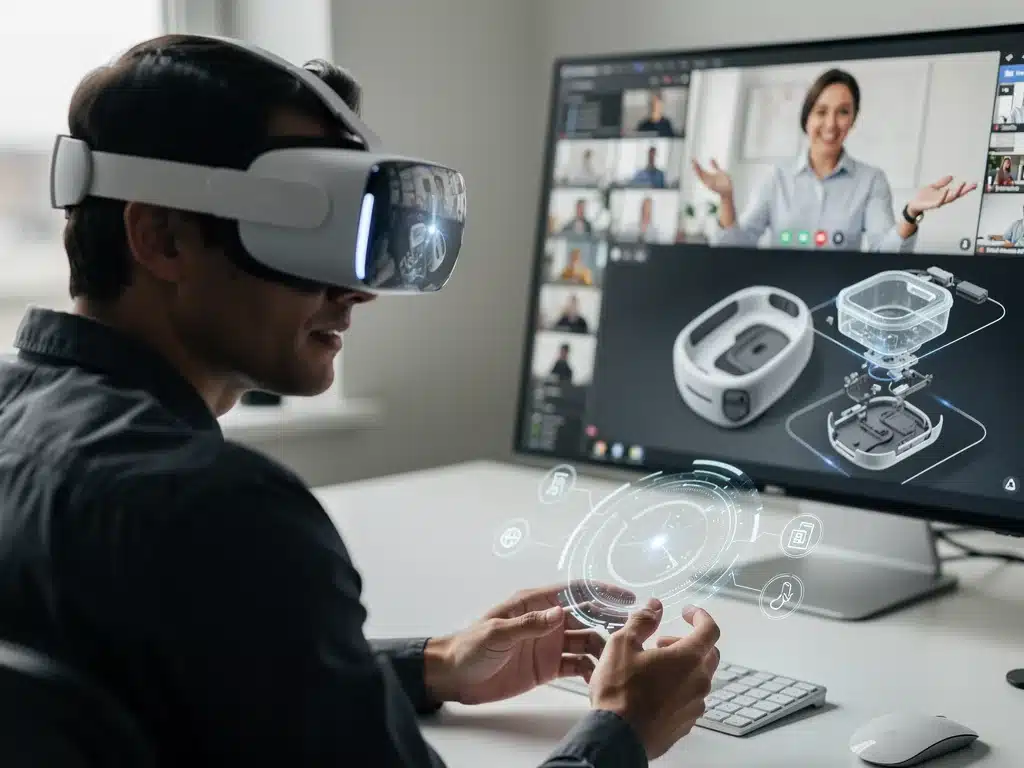
Virtual reality and augmented reality can add immersive features, but they are not required for every digital showroom and should not be treated as universal components.
Many effective wholesale platforms instead focus on high-quality product imagery, interactive line sheets, inventory information and integrated ordering.
3D Product Visualisation
Three-dimensional design tools allow brands to create digital versions of garments before or alongside physical prototypes.
Accurate 3D assets can show silhouette, colour and construction from multiple angles, helping teams and buyers evaluate products remotely.
The quality of the result depends on accurate material data and modelling, meaning digital representations cannot always perfectly reproduce the physical experience of fabric.
Immersive Virtual Reality Experiences
Virtual reality can allow users to navigate simulated showroom environments and interact with digital products through compatible hardware.
For some brands, this can provide an engaging presentation format for remote launches, collaborative sessions or specialised buyer experiences.
However, VR remains only one option within the broader digital-showroom category and may not be necessary when simpler web-based tools satisfy wholesale requirements.
Advanced 3D Rendering and Augmented Reality
High-quality rendering can help brands present product details without requiring every variation to exist as a separate physical sample.
Augmented reality adds another layer by placing digital objects within a real environment through a phone, tablet or compatible wearable device.
These technologies can support presentation and decision-making, but physical inspection may still be required when accurate texture, fit or material behaviour is particularly important.
Real-World Examples of Digital Wholesale
Digital wholesale platforms have published a growing number of case studies showing how individual brands have changed their showroom and ordering processes.
These examples provide useful evidence that the technology can improve specific workflows, but results from one company should not be assumed to apply to every brand.
Factors including company size, wholesale network, previous technology and operating model strongly influence the benefits achieved after implementation.
Loake and Digital Wholesale
Footwear brand Loake adopted JOOR to support digital wholesale activities and provide buyers with access to a virtual showroom.
According to JOOR’s case study, the company reported a 20% increase in reorders while also simplifying order placement and maintaining digital access for retail partners.
This result relates specifically to Loake’s experience and should be treated as a company case study rather than an expected outcome for every platform user.
Brodie Cashmere and Buyer Engagement
Brodie Cashmere adopted a virtual showroom and digital lookbooks to make its wholesale ordering and buyer-management processes more efficient.
The brand reported that ordering previously required extensive manual work, whereas buyers could later browse products and place orders through a digital environment.
It also uses digital tools during physical showroom appointments, demonstrating how virtual technology can complement rather than completely replace in-person wholesale selling.
Reducing Physical Samples Through 3D
Browzwear publishes case studies in which individual apparel companies have significantly reduced physical sampling after implementing 3D design workflows.
Examples listed by the company include one customer reporting a 75% reduction in physical samples and another reducing sales samples by 50%.
These figures demonstrate what may be possible in particular workflows, but they are vendor-reported case studies and should not be interpreted as guaranteed industry averages.
Challenges and Considerations in the Digital Transition
The benefits of digital showrooms need to be balanced against implementation costs, technology integration and the limitations of digital product representation.
Brands may need new software, product data, training and processes before digital platforms become efficient parts of everyday sales operations.
Successful implementation therefore depends on workflow redesign as much as on purchasing a particular technology or subscribing to a platform.
Technology Integration and Training
Digital wholesale platforms often need to exchange information with enterprise resource planning, inventory and customer relationship management systems.
Poor integration can create duplicate data or manual work, reducing some of the efficiency the technology was intended to provide.
Sales teams and buyers also need sufficient training so the platform becomes part of normal workflows rather than an additional administrative task.
Product Accuracy and the Need for Physical Touch
Digital imagery can communicate colour, silhouette and construction effectively, but it cannot fully reproduce every physical characteristic of a garment.
Fabric weight, softness, stretch and detailed fit may still be easier to evaluate through a physical sample, particularly for premium or technically complex products.
For this reason, many brands are likely to combine fewer carefully selected samples with comprehensive digital collections rather than eliminating physical samples entirely.
Implementation Costs
Digital showrooms are not cost-free because brands may need software subscriptions, 3D specialists, integration work and digital asset creation.
The return on investment depends on whether these expenses are offset by reductions in sampling, travel, processing time and other operational costs.
Smaller brands should therefore compare expected benefits with technology and staffing requirements before assuming that a complex solution will automatically reduce expenditure.
The Future Outlook for Digital Showrooms
Digital showrooms are likely to become increasingly connected with ordering, inventory, analytics and product-development systems rather than operating as isolated presentation tools.
The future also appears increasingly hybrid, with digital platforms supporting physical market weeks, appointments and showroom experiences instead of eliminating them altogether.
Improved data integration may ultimately be more important than highly immersive graphics because it can connect product presentation directly with commercial decision-making.
AI and Personalised Buyer Experiences
Artificial intelligence may help digital wholesale platforms organise large catalogues and identify products that are more relevant to individual buyers.
Recommendation systems could use previous orders, regional demand and product performance to help sales teams prepare more relevant presentations.
These systems remain decision-support tools rather than guaranteed predictors of demand, because buyer behaviour and fashion trends can change unexpectedly.
Analytics and Inventory Planning
Digital ordering produces structured information that brands can use to understand which products are attracting buyer interest before larger production commitments are made.
Sales teams can analyse orders across territories, accounts and product categories to support assortment and inventory discussions.
Better data can improve planning, but algorithms and dashboards still depend on accurate inputs and should complement rather than replace commercial judgement.
Integrated Digital Ecosystems
The longer-term opportunity is to connect design, sampling, wholesale presentation, ordering and inventory within a more continuous digital workflow.
A product created digitally during development could potentially move through later commercial stages without repeatedly recreating the same information.
This reduces duplication and may accelerate decision-making, making workflow integration one of the most significant potential benefits of digital transformation.
Environmental and Sustainability Implications of Digital Showrooms
Digital Showrooms can support sustainable practices by reducing selected physical samples, shipments and business travel.
However, sustainability benefits should not be described as automatic because digital infrastructure also uses electricity, hardware and data-centre resources.
A credible environmental assessment should compare the complete workflow before and after digitisation rather than assuming that every digital process has a smaller footprint.
Reducing Physical Sample Waste
Physical fashion samples require fabric, trims, manufacturing labour, packaging and transportation even when they never become commercial products.
Using digital prototypes during some stages can reduce the number of samples produced and therefore reduce material use and associated shipping.
CLO and Browzwear both identify lower physical sampling and shipping as potential benefits of virtual garment workflows, although results vary by company and product category.
Reducing Travel and Transport
Remote buyer meetings can replace selected international trips, particularly when physical inspection of every item is unnecessary.
Reducing sample shipments can also decrease freight activity between design offices, manufacturers, showrooms and wholesale customers.
These changes can lower transport-related emissions, but companies need actual travel and freight data before quantifying their environmental benefit.
Sustainability Claims Need Measurement
A digital showroom should not automatically be described as sustainable simply because products are presented through a screen.
Brands should measure reductions in sample production, freight, travel and waste and compare them with the additional technology required to operate the digital workflow.
Documented results provide a stronger basis for sustainability claims than broad statements about digital technology being environmentally friendly.
| Key Point | What the Evidence Supports |
|---|---|
| Operational Savings | Digital workflows can reduce sampling, shipping, travel and processing costs, but there is no universal 30% savings rate. |
| Technology | 3D visualisation and digital ordering are central tools, while VR and AR are optional enhancements. |
| Physical Samples | Digital prototypes can reduce sample requirements, but some physical validation remains important. |
| Sales | Virtual showrooms can provide global buyer access and streamline wholesale ordering. |
| Future Development | AI, analytics and deeper ERP integration may make digital wholesale increasingly personalised and data-driven. |
Frequently Asked Questions About Digital Showrooms
A digital showroom is an online B2B environment where brands present collections, product information and, in many cases, wholesale ordering tools to retail buyers.
Not necessarily. Digital showrooms can reduce costs associated with samples, shipping, travel and physical presentations, but there is no reliable universal 30% savings figure that applies to every brand.
Not always. Digital prototypes can significantly reduce the number of samples needed, but physical products may still be necessary to evaluate fabric, fit, construction and other characteristics.
No. Many digital showrooms operate through standard web browsers or apps using product imagery, video, 3D assets and ordering tools. VR can provide additional immersion but is not required.
No. Platforms exist for businesses of different sizes, although implementation costs, integration requirements and expected returns should be evaluated before adoption.
No. They can reduce physical samples, shipping and travel, but the actual environmental benefit depends on how the technology changes the company’s overall workflow.
Impact and Implications
Digital showrooms are becoming an important part of the wider transformation of fashion wholesale, particularly where brands operate across multiple markets.
Their strongest advantages come from reducing unnecessary physical processes, improving remote buyer access and connecting product presentation more directly with ordering and data.
The future is likely to combine digital and physical experiences, with 3D technology, AI and analytics expanding capabilities while brands continue to measure whether each investment produces meaningful commercial value.