Future of Fashion Retail 2026: 3 Technologies Reshaping In-Store
Advertisements
The Future of Fashion Retail in 2026 centres on artificial intelligence, virtual try-on technology and connected omnichannel retail, with practical examples, limitations and issues consumers and retailers should monitor.
Fashion Retail reflects a retail industry moving beyond isolated digital experiments towards technologies that connect product discovery, stores, inventory and customer service.
Artificial intelligence is increasingly used for recommendations, search and operational decisions, while augmented-reality and AI-based try-on tools are giving shoppers new ways to visualise products before buying.
Advertisements
At the same time, physical stores are becoming more closely connected with websites, apps, fulfilment systems and customer accounts, making the boundary between online and in-store shopping less distinct.
The First Technology: AI-Powered Personalisation
Artificial intelligence has become an important part of modern Fashion Retail infrastructure, supporting functions ranging from product discovery and customer service to demand forecasting and merchandising.
In fashion retail, AI systems can use authorised customer and product data to suggest relevant products, improve search results and help associates locate alternatives or complementary items.
The quality of these experiences depends on the data available, the accuracy of the model and the retailer’s ability to use personal information responsibly.
Predictive Analytics for Inventory Management
AI-based forecasting can analyse historical sales, seasonal patterns, promotions and other signals to help retailers estimate demand for particular products.
This can support purchasing and allocation decisions, but predictions remain imperfect because fashion demand can change quickly in response to weather, trends, promotions and unexpected events.
The practical goal is therefore not to eliminate stockouts or excess inventory entirely, but to give planners better information for making replenishment and assortment decisions.
- Demand forecasts can support stock allocation and replenishment.
- Real-time inventory data can help staff locate available products.
- Forecast accuracy still depends on data quality and changing market conditions.
Personalised Styling Assistants
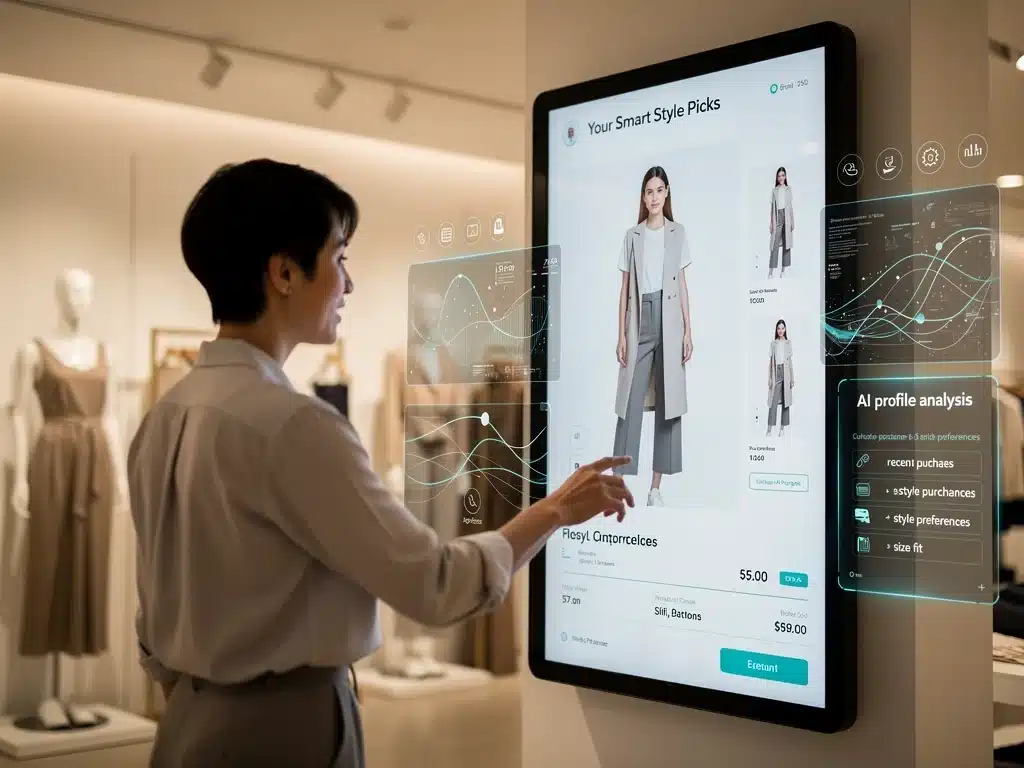
AI styling tools can generate recommendations based on information such as previous purchases, stated preferences, browsing behaviour or products a customer is currently considering.
Retailers including fashion and beauty brands are experimenting with conversational tools that help shoppers narrow large catalogues and discover combinations more quickly.
These systems should not be assumed to know someone’s body, personal identity or social-media activity unless the shopper has provided relevant data and the retailer has an appropriate basis for using it.
The Second Technology: AR and AI-Powered Virtual Try-On
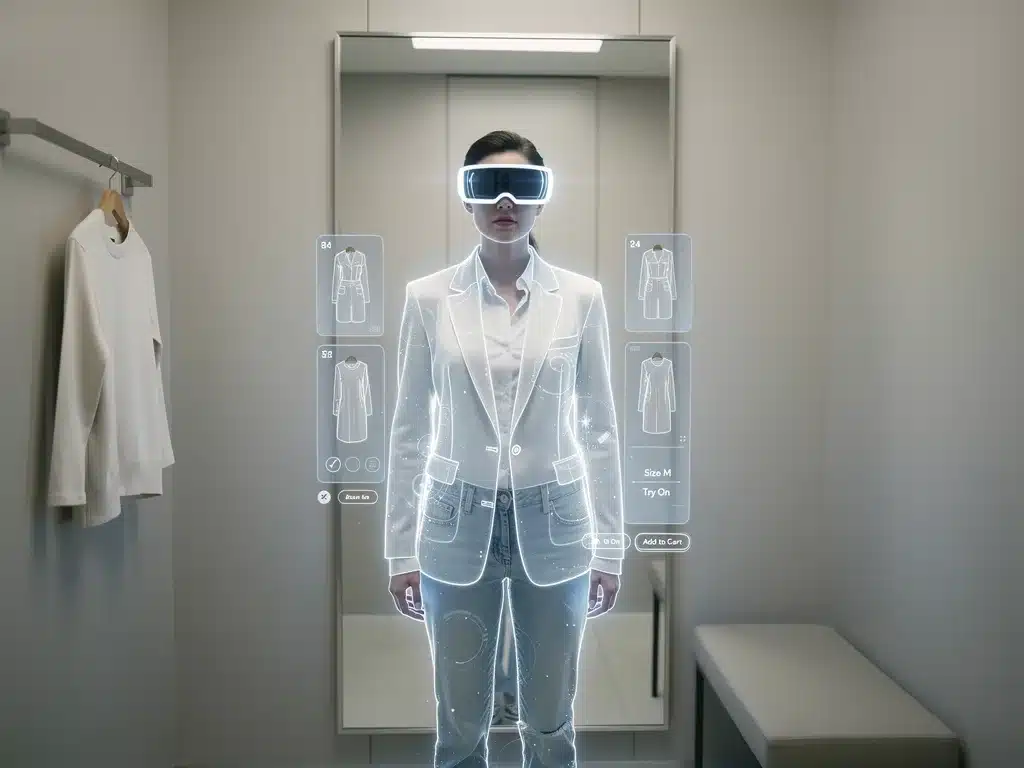
Virtual try-on is becoming more visible across fashion, beauty and accessories, using augmented reality, computer vision or generative AI to help shoppers preview products digitally.
In stores, these technologies can appear through mirrors, screens, tablets or mobile devices, while similar experiences are also increasingly available through ecommerce platforms.
The technology can improve product visualisation, but a digital preview should not automatically be interpreted as a precise prediction of real-world size, fit, fabric movement or comfort.
Virtual Try-On Experiences
An AR mirror generally uses cameras, sensors and software to overlay a digital representation of a product onto a live image of the shopper.
Newer AI systems can also generate images showing clothing on a person’s uploaded photograph, creating another way to explore colour, silhouette and styling combinations.
Both approaches can help shoppers explore products, but accuracy varies significantly according to garment data, body representation, software quality and the type of item being visualised.
- Virtual try-on can make comparing colours and styles faster.
- It may encourage shoppers to explore products they had not initially considered.
- Digital visualisation does not guarantee accurate physical sizing or drape.
Interactive Product Displays
AR and connected displays can also provide additional information when a customer scans or selects a product inside a store.
This may include available sizes, colours, styling suggestions, material information, care instructions or inventory elsewhere in the retailer’s network.
Whether sustainability or sourcing information is meaningful depends on the quality and verification of the underlying data rather than on the display technology itself.
The Third Technology: Connected Omnichannel Fashion Retail
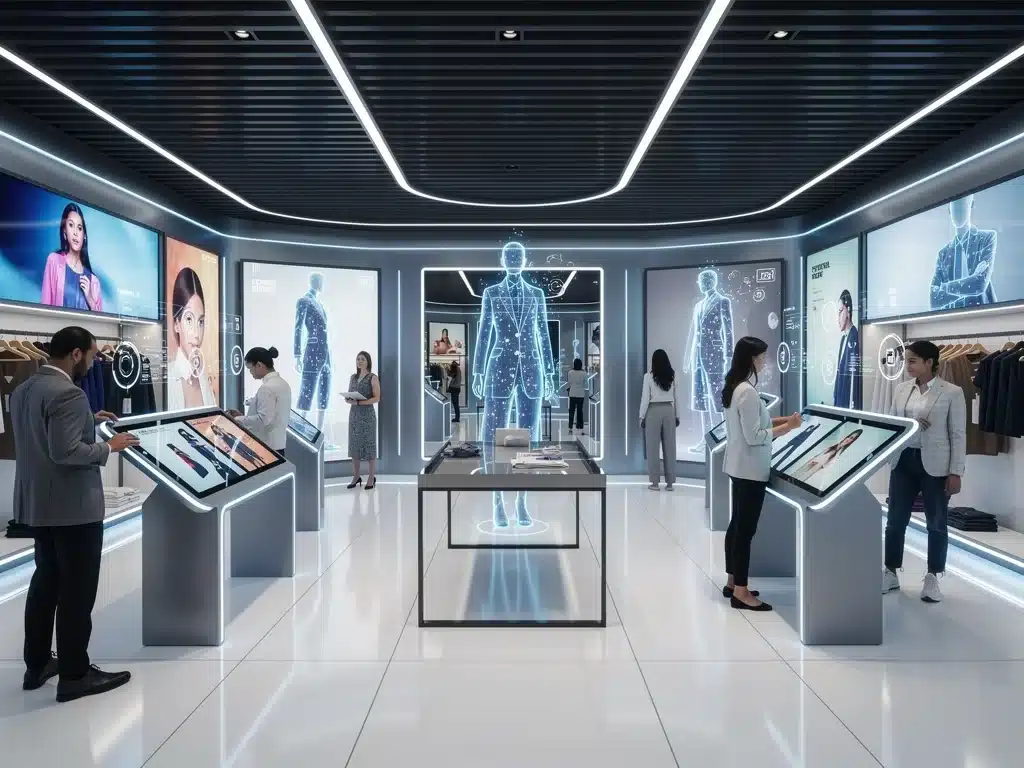
One of the most important changes in Fashion Retail is the integration of physical stores with ecommerce, mobile apps, customer service, inventory and fulfilment systems.
Customers increasingly expect to research online, visit a store, check inventory, purchase through another channel and handle returns without starting the entire process again.
For retailers, achieving that experience requires accurate data and connected systems rather than simply offering both a website and physical stores.
Click-and-Collect and Store Fulfilment
Click-and-collect lets shoppers order online and retrieve eligible products from a physical location, combining digital purchasing with the convenience of local collection.
Some retailers also use stores to fulfil ecommerce orders, effectively turning part of the shop network into distributed inventory and fulfilment capacity.
These models can improve convenience, but their effectiveness depends on inventory accuracy, staffing, order preparation and the economics of each retailer’s fulfilment network.
- Click-and-collect can provide an alternative to home delivery.
- Stores can sometimes fulfil ecommerce orders from local inventory.
- Reliable real-time inventory data is essential for both models.
Digital Tools for Store Associates
Tablets and mobile systems can give store associates access to product information, inventory availability and authorised customer information while assisting shoppers.
This can help staff find another size, locate stock at a nearby store or order an unavailable product for delivery without sending the customer away.
The technology is most useful when it supports human service rather than forcing staff to navigate disconnected systems while a customer waits.
AI Is Moving from Experiments to Fashion Retail Operations
By 2026, the retail conversation around AI has increasingly shifted from experimentation towards determining which applications can produce measurable operational or customer benefits.
Industry discussions now include conversational product discovery, customer-service automation, forecasting, merchandising, content generation and emerging shopping agents that can research or compare products for consumers.
Not every project succeeds, making integration quality, employee adoption, governance and measurable business outcomes as important as the AI model itself.
Agentic Shopping Is an Emerging Development
AI assistants are beginning to move beyond answering questions towards performing more complex shopping tasks such as product comparison and guided discovery.
Industry research in 2026 shows consumers already using AI for activities including researching products, finding reviews and searching for deals.
Fully autonomous purchasing remains an evolving area, so retailers are preparing for agent-driven commerce while still serving customers through conventional websites, apps and stores.
Virtual Try-On Still Has Important Limitations
Virtual try-on can improve product exploration, but current systems vary in how realistically they represent clothing, accessories and individual body characteristics.
Showing how a colour or general silhouette might look is different from accurately determining whether a specific garment will feel comfortable or fit correctly.
Retailers should therefore present these tools as decision aids rather than substitutes for accurate measurements, size guidance or physical fitting when those factors matter.
Visualisation Is Different from Sizing
Generative AI can create highly realistic images even when the underlying representation does not correspond perfectly to real garment dimensions.
A convincing image may therefore provide styling inspiration without functioning as an accurate technical fitting simulation.
Retailers that combine virtual visualisation with reliable garment measurements and sizing information can provide a more useful overall experience.
Fashion Retail Is Becoming More Data-Dependent
AI personalisation and omnichannel services depend increasingly on collecting and connecting information about products, transactions, interactions and customer preferences.
This can make recommendations and service more relevant, but it also increases the importance of privacy, security, consent and limits on how personal information is used.
The challenge for retailers is to create useful personalisation without making customers feel that the brand knows or infers more about them than they reasonably expected.
Privacy Is Part of the Customer Experience
Retail research in 2026 demonstrates a tension between consumers wanting relevant experiences and remaining concerned about misuse, security and unwanted marketing.
Transparency about what information is collected, why it is needed and what benefit the shopper receives can therefore be as important as the personalisation itself.
Retailers operating across the United States also need to account for applicable state privacy requirements rather than treating data governance as a purely technical issue.
Data Security and AI Governance
More connected Fashion Retail systems create larger quantities of customer and operational data that need to be protected against unauthorised access, misuse and cybersecurity threats.
Retail AI also introduces governance questions involving accuracy, discrimination, transparency, data provenance and the extent to which automated decisions should be reviewed by people.
Responsible adoption therefore requires both technical controls and clear organisational responsibility for how AI systems are selected, tested and monitored.
California’s Privacy Rules Matter in 2026
The California Consumer Privacy Act gives eligible consumers rights involving access, deletion and certain uses or sharing of personal information.
Additional California regulations concerning risk assessments, cybersecurity audits and automated decision-making technology took effect in 2026 for businesses to which the relevant requirements apply.
Retailers using advanced personalisation should therefore evaluate both customer expectations and the specific legal obligations that apply to their data practices.
- Collect only information appropriate for the intended purpose.
- Maintain security controls for sensitive customer and business data.
- Provide required privacy choices and disclosures where applicable.
Sustainability Technology and Product Traceability
Technology can help fashion companies collect and communicate more detailed information about sourcing, production and materials.
Digital records, product identifiers and traceability platforms may help connect information across suppliers, manufacturers and retailers.
However, technology does not automatically prove that a product is sustainable, ethical or environmentally preferable; those claims still depend on accurate underlying evidence.
Blockchain for Supply Chain Traceability
Blockchain is one possible technology for recording transactions or supply-chain events in a distributed ledger, but it is not the only approach to traceability.
A blockchain record can make previously entered information difficult to alter, yet it cannot independently verify whether the original information entered was truthful or complete.
For fashion retailers, reliable supplier verification, audits and data standards remain important regardless of which database technology stores the information.
Manufacturing Innovation
Fashion companies continue to explore technologies intended to reduce material waste, water consumption, energy use or production inefficiencies.
Examples include digital sampling, improved dyeing processes, automated cutting, on-demand production and new material-development techniques.
The environmental benefit of each method should be evaluated across its actual lifecycle rather than assuming that a newer technology is automatically more sustainable.
Experiential Fashion Retail and the Role of Physical Stores
Physical stores remain relevant even as online discovery and AI-assisted shopping expand, with many retailers using stores for service, fulfilment and brand experiences as well as transactions.
Events, product demonstrations, alterations, styling appointments and community activities can give customers reasons to visit that cannot be replicated exactly by ecommerce.
The strongest store strategies increasingly combine human service with digital convenience rather than positioning technology and employees as competing alternatives.
In-Store Events and Community
Workshops, product launches and collaborations can help brands turn stores into destinations rather than locations used solely for transactions.
These activities can deepen engagement when they genuinely match the retailer’s customer base and brand positioning.
The effectiveness of experiential retail still needs to be measured rather than assuming every event automatically increases sales or loyalty.
- Workshops can provide education or styling assistance.
- Events can introduce customers to products and collaborators.
- Retailers should measure participation, customer response and commercial impact.
Human Service Remains Important
AI can retrieve information and generate recommendations, but experienced store associates provide context, judgement and interpersonal interaction that software does not always reproduce well.
Digital tools can strengthen that service when they give staff faster access to stock information, product details or customer requests.
The future store is therefore likely to combine knowledgeable people with connected systems rather than remove the human element altogether.
Challenges of Investing in Retail Technology
AI, virtual try-on and omnichannel infrastructure can require significant spending on software, integrations, devices, data systems, cybersecurity and employee training.
The business case differs by retailer, meaning a technology that works well for a global fashion chain may not provide the same return for a smaller regional business.
Retailers increasingly need to prioritise technologies that solve a defined customer or operational problem rather than adopting innovation solely because it is fashionable.
Moving Beyond Technology Pilots
A successful demonstration does not guarantee that a technology can be scaled across hundreds of stores, thousands of employees and complex legacy systems.
Implementation also requires workflow changes, maintenance, training and reliable data, all of which can determine whether a pilot eventually creates meaningful value.
In 2026, retail technology discussions increasingly emphasise measurable execution and integration rather than the number of experimental projects a company can announce.
Upskilling the Workforce
New retail systems change the skills employees need, particularly when associates use AI tools, connected inventory systems or digital clienteling platforms.
Training should explain both how to operate the technology and when human judgement is necessary because automated outputs may be incomplete or inaccurate.
Well-designed tools can help employees work more effectively, while poorly integrated technology can simply add another layer of complexity to store operations.
| Key Technology | Impact on the In-Store Experience |
|---|---|
| AI Personalisation | Can support product recommendations, search, customer service and inventory decisions when appropriate data is available. |
| Virtual Try-On | Helps customers visualise products digitally, although it does not always predict physical fit or drape precisely. |
| Omnichannel Integration | Connects stores, ecommerce, inventory, fulfilment and service to reduce friction across the customer journey. |
| Supporting Technologies | Traceability, privacy, cybersecurity and workforce tools help determine whether the three core technologies can operate responsibly at scale. |
Frequently Asked Questions About Fashion Retail Technology
Three of the most important areas are AI-powered personalisation and operations, AR or AI-enabled virtual try-on, and omnichannel systems that connect physical stores with digital commerce and fulfilment.
AI can support product recommendations, search, inventory decisions and store associates, but its effectiveness depends on accurate data, appropriate governance and the specific retail application.
Not necessarily. Virtual try-on can provide useful visualisation, but realistic-looking images do not always reproduce exact sizing, fabric drape, movement or physical comfort.
It allows inventory, ecommerce, stores, fulfilment and customer service to work together so shoppers can move between channels with fewer interruptions.
No. Blockchain can help preserve supply-chain records, but the accuracy and credibility of sustainability or ethical claims still depend on the quality and verification of the information entered.
Looking Ahead
The Future of Fashion Retail in 2026 is increasingly defined by AI, digital product visualisation and connected commerce rather than by one isolated piece of store technology.
The next stage will depend on how successfully retailers turn these tools into reliable everyday experiences while protecting privacy, maintaining accurate data and giving employees systems they can actually use.
Consumers should expect continued experimentation, but the most important developments will be those that move beyond demonstrations and deliver measurable improvements in discovery, service, convenience and trust.